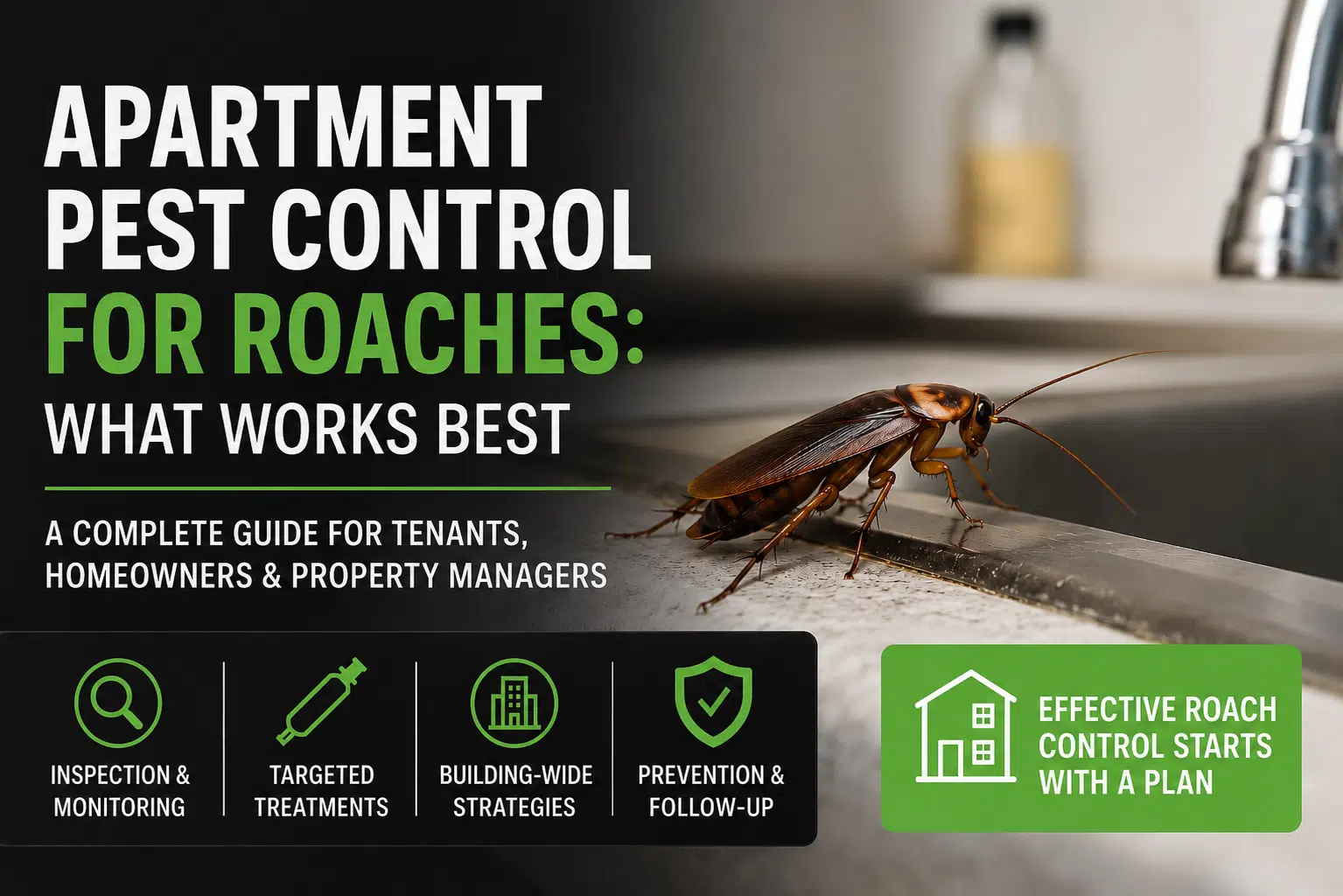
TLDR: What Works Best for Apartment Roach Control?
The best apartment pest control for roaches is not a one-time spray. It is an Integrated Pest Management plan, or IPM, that includes inspection, monitoring, targeted baiting, moisture control, sanitation improvements, exclusion work, and follow-up.
That matters because roaches in apartments often move through shared walls, plumbing lines, electrical conduits, trash areas, utility spaces, and neighboring units. If only one unit is treated while the source remains active nearby, the problem can come back fast.
For most apartment roach problems, especially German roaches, the best approach includes:
- A real inspection before treatment starts
- Sticky monitors to find the heaviest activity
- Gel bait and targeted product placement
- Crack-and-crevice treatments where roaches hide
- Moisture and sanitation recommendations
- Coordination with property managers when needed
- Follow-up visits to confirm the activity is dropping
Spray-only treatments may kill visible roaches, but they often miss hidden harborages and can push activity deeper into the building. If you are dealing with repeat sightings, daytime roaches, multiple affected units, or activity around kitchens and bathrooms, a coordinated plan is usually the safer choice.
For help in North Texas, Preferred Pest Management offers apartment pest control in Plano, TX and targeted cockroach control in Plano for renters, homeowners, property managers, and commercial spaces.
Apartment pest control for roaches gets tricky fast because the problem usually is not just your apartment. In multifamily buildings, one sighting can point to activity in walls, plumbing lines, neighboring units, shared trash areas, or utility spaces that connect more than one unit.
That is why roach control in apartments needs a different strategy than a basic one-time spray. This guide explains what actually works, what usually fails, and how to judge whether a pest control company understands apartment roach work or is just selling a quick visit.
Here is the short answer up front: the best apartment roach control is an Integrated Pest Management approach, also called IPM. That means inspection, monitoring, targeted baiting, moisture control, sanitation improvements, exclusion work, and follow-up. It does not mean walking into the unit, spraying baseboards, and hoping the problem disappears.
If you want the quick roadmap, this is what you will learn:
- Why apartment roaches spread so easily
- Why spray-only service often fails
- Which treatment methods work best
- What a real roach inspection should include
- Why building-wide coordination matters
- How to compare DFW pest control providers
- What warranty language actually means
- How to prevent reinfestation after treatment
If you are in Plano or the surrounding North Texas area and need help with an active issue, Preferred Pest Management offers apartment pest control in Plano, TX and targeted cockroach control in Plano for homes, renters, property managers, and commercial properties.
Why Roaches Are So Hard to Control in Apartments
Roaches love apartments for the same reason people do: steady warmth, water, food, and lots of places to hide. The difference is that roaches do not care about lease lines, ownership boundaries, or which unit they started in.
In apartment buildings and condos, shared walls, plumbing chases, electrical conduits, vents, and utility lines can give German roaches hidden routes from one unit to another. Purdue Extension explains that cockroach control in multi-family housing is different because infestations can involve residents, property managers, maintenance teams, and pest control professionals working together.
That changes what “works best.” A treatment that might knock down a contained issue in a single-family home can fail in a multifamily property because the pressure keeps coming from next door, above, below, or from a common area.
The Real Problem Is Shared-Building Pressure
When people say, “I only saw one roach,” that can sound reassuring. In an apartment, it often is not.
One German roach can be an early warning sign of a larger hidden issue, especially because German roaches reproduce quickly and hide extremely well. A Rutgers study of low-income apartment buildings found that among apartments with trap count data, 30% had German cockroaches, and more than a third of residents with infestations were unaware roaches were present.
That is one reason experienced providers talk about adjacent units, shared utility routes, and follow-up inspections early in the conversation. If a company only focuses on the one roach you saw in your kitchen, they may be treating the visible symptom instead of the source.
Roaches Are More Than Gross, They Affect Health
Roaches are a health issue, not just a nuisance. A 2025 review described cockroaches as major urban pests and disease vectors, noting that they can carry pathogens and contribute to indoor allergen concerns.
The indoor air quality side matters more than most people realize. NC State researchers found a link between cockroach infestation size and indoor levels of allergens and endotoxins. They also found that lowering cockroach numbers through pest control triggered significant reductions in those indoor contaminants.
In plain English: partial control is not enough if you want a healthier apartment, kitchen, or shared building environment.
What Actually Works Best for Apartment Pest Control
The most reliable approach is IPM. The EPA says pest control in multifamily housing works best when housing managers, maintenance staff, residents, and pest control professionals use a coordinated Integrated Pest Management strategy.
IPM is not a buzzword. It is a practical system. It means finding where roaches live, what is helping them survive, how they are moving, and which methods can remove them with the least unnecessary product use.
That usually beats one-time, spray-heavy service because it deals with the conditions that let roaches survive in the first place.
Why Spray-Only Treatment Often Fails
Spray-only service sounds decisive. In apartment roach control, it is often the opposite.
In apartments, sprays alone can push German roaches deeper into walls and into neighboring units. Some repellent products can also interfere with bait acceptance, which matters because baiting is often the backbone of German roach control.
More chemical does not automatically mean better control. Sometimes it just means more scattered bugs and less visibility into where the main harborages are.
There is another problem: resistance. A 2025 review on cockroaches as urban pests identified insecticide resistance as one of the challenges that complicates traditional control methods. So if a company’s entire pitch is “we spray hard,” that is not reassuring. It is dated.
What an Effective IPM Plan Includes
A solid apartment roach program starts with inspection, then monitoring, then precise treatment.
Good providers use sticky traps to map activity, place gel baits where roaches actually travel, apply crack-and-crevice products only where needed, and come back to reassess and refresh materials.
They also address the conditions feeding the infestation. That means sanitation guidance, moisture reduction, and sealing entry points. The EPA’s resident guidance for multi-family housing specifically points to housekeeping, trash handling, food storage, and preparation for pest control service as important parts of the process.
If you want a deeper benchmark for what local professional service should look like, our page on cockroach control in Plano explains how we approach inspection, species identification, treatment, and prevention.
If you are comparing service models, it also helps to understand when repeat visits outperform a single appointment. This matters because apartment roach work almost always involves more than one pass. You can learn more in our guide on ongoing pest control vs. one-time treatment.
The Best Treatment Methods for Roaches in Apartments
Not every method belongs in every unit. Good pest control companies should be able to explain why they are using a given tool, where they will place it, and what result they expect from it.
The best apartment roach control usually combines several targeted tools rather than relying on one product.
Baits and Gel Placements
For German roaches, gel baits and bait placements are often the workhorses.
They reach hidden populations without blasting product across every surface, and they can keep working after the technician leaves. Roaches contact or consume the bait, move through harborage areas, and help spread the effect through the population.
Placement matters a lot. So does refreshing the bait when it dries out, gets contaminated, or stops being attractive.
One assessment-based pest management study in housing authorities used cockroach trap counts to guide gel bait placement and found that cockroach populations in test units were typically reduced by more than 90%. German cockroach infestations were eliminated in 49 of 65 test units during the study.
That is the kind of result you want a provider to understand and build around.
Sticky Traps and Monitoring Tools
Sticky traps are not a gimmick. They are how a serious company verifies activity, identifies hotspots, and measures whether treatment is working.
They also help avoid guesswork. Instead of treating every cabinet the same way, monitors show where roaches are actually active.
That matters for health too. NC State researchers found that cockroach infestation size was linked with indoor allergen and endotoxin levels, which is one reason objective monitoring matters.
If a company never mentions monitors, ask why. Data-driven pest control is usually better pest control.
Dusts, Crack-and-Crevice Products, and Limited Sprays
Dusts and non-repellent crack-and-crevice products have a place, especially in voids, penetrations, and hard-to-reach harborage areas.
Limited spray use can also make sense in targeted situations. The key word is limited.
Precision beats blanket treatment in apartments because you are dealing with hidden movement routes and shared building pressure. A surface-level spray may kill what is exposed, but the real population is often behind appliances, inside wall voids, near warm motors, around plumbing gaps, or inside neighboring units.
For many buyers, this is also where it helps to know the difference between residential-focused service and business-grade programs. If you manage mixed-use properties, restaurants, offices, or shared commercial spaces, our commercial pest control services may be a better fit than a basic residential visit.
What to Expect During an Apartment Roach Inspection and Service Visit
A qualified company should inspect before treating. That sounds obvious, but plenty of providers still walk in with a tank and start spraying.
That is not a roach control plan. That is a product application.
A real inspection tells the technician what species is present, how heavy the activity is, where the pressure is coming from, and what should happen next.
Where Pest Control Companies Should Inspect and Treat
High-risk areas usually include:
- Kitchens
- Cabinet hinges and cabinet backs
- Under sinks
- Around dishwashers
- Around refrigerators
- Behind stoves
- Bathrooms
- Laundry areas
- Utility penetrations
- Pipe chases
- Shared wall zones
- Trash rooms
- Compactor areas
- Maintenance rooms
- Break rooms and shared kitchens
There is a reason kitchens get so much attention. Roaches find food, water, heat, and shelter there. NC State’s research also noted that larger cockroach infestations were tied to higher indoor allergen and endotoxin levels, reinforcing why infested units and kitchen areas deserve serious attention.
How to Prepare Your Apartment or Unit
Prep should be practical, not absurd.
Usually, that means clearing out under sinks, reducing clutter, storing food in sealed containers, cleaning up grease and crumbs, and making sure the technician can reach problem spots.
Some companies will ask you to empty certain cabinets. If they do, they should tell you exactly which ones and why.
Residents also play a role. The EPA says residents in multi-family housing can support pest control by preparing the unit for service, following housekeeping rules, reporting leaks, and managing trash properly.
That said, prep alone will not solve a building-wide problem. A clean apartment can still get roaches if nearby units, pipe gaps, wall voids, leaks, or shared trash areas are feeding the infestation.
How Many Visits It Usually Takes
Roach control in apartments is rarely one and done.
Eggs hatch later. Hidden harborages take time to collapse. Bait placements may need to be refreshed. Reinfestation pressure from nearby units can keep the cycle alive if only one apartment gets attention.
That is why vague promises of instant elimination should make you nervous.
If you are weighing proposals, it is worth reading our article on whether one-time roach treatment is enough. The short version is simple: one visit can help in light, contained situations, but apartment roach issues often need follow-up.
Building-Wide Roach Control: The Part Most Companies Underplay
This is where a lot of apartment pest control programs fall apart.
The company treats the complaint unit, leaves, and everyone acts surprised when the roaches return.
In multifamily housing, that is not a mystery. It is a process failure.
Why Treating One Unit Alone Can Backfire
Pressure one population with poor methods and roaches can relocate.
After bad spray work, roaches often move deeper into wall voids, utility chases, and adjacent units. So yes, treating one unit alone can make the building-wide pattern harder to track when the method is wrong.
The EPA notes that pest control in multi-family housing may require coordination between property managers, residents, maintenance staff, and pest management professionals.
That coordination is inconvenient, but it is often the difference between a lasting fix and a recurring complaint.
What Property Managers and Landlords Should Coordinate
Apartment roach control is partly an operations issue.
Access scheduling matters. Leak repairs matter. Documentation matters. Resident communication matters. Repeat service planning matters.
The EPA’s housing manager guidance explains that effective pest control in multifamily housing depends on defined roles, including property management, maintenance, residents, and pest professionals working through IPM responsibilities.
That means the vendor cannot be expected to fix every condition alone. If leaking pipes, food debris, trash handling problems, and structural gaps stay in place, roach pressure can continue even after a good treatment.
Tenant, Owner, and Vendor Roles
Tenants or residents usually handle reporting, basic housekeeping, food storage, and access.
Owners and managers handle structural repairs, vendor coordination, common-area sanitation, trash systems, and maintenance conditions.
The pest control company handles inspection, treatment design, monitoring, product placement, follow-up, and documentation.
Clear roles reduce finger-pointing, which is honestly one of the biggest delays in multifamily pest work.
How to Compare Roach Pest Control Companies in DFW
If you are in vendor selection mode, the goal is not to find the cheapest quote.
The goal is to find the company least likely to waste your time.
A cheap spray visit that fails can cost more than a stronger plan that includes inspection, monitoring, follow-up, and realistic expectations.
Questions to Ask Before You Book
Ask direct questions:
- Do you use IPM for German roaches?
- Will you inspect adjacent units if needed?
- What products and methods do you rely on?
- Do you use bait, monitors, and crack-and-crevice treatment?
- How many follow-up visits are included?
- How do you measure progress?
- What prep is required from residents or staff?
- What does your warranty actually cover?
- Do you have experience with apartments and multifamily buildings?
A provider should answer clearly, without hiding behind vague “proprietary methods.”
For a fuller screening list, review our guide on how to choose the best cockroach exterminator in Plano.
Green Flags That Signal Real Expertise
Good signs include a written treatment plan, clear scope of work, monitoring tools, non-repellent strategy, realistic expectations, and experience with multifamily properties.
You also want someone willing to discuss limitations. Honest providers do that.
If a building has long-running roach pressure, shared utility routes, inconsistent resident access, or sanitation issues in common areas, a good provider should say so. They should not pretend every apartment roach issue can be fixed with a single visit and no cooperation.
For restaurants, mixed-use buildings, or commercial spaces, documentation matters even more. Restaurant owners in particular should expect tighter process control than a basic residential visit. If that applies to your property, read our guide on restaurant roach control before comparing vendors.
Red Flags to Watch For
Be cautious if you hear:
- “One-time guaranteed elimination”
- “We just spray everything”
- “No inspection needed”
- “Follow-up is not necessary”
- “You do not need to know what products we use”
- “It does not matter what species it is”
- “We only treat the complaint unit, no matter what”
Another red flag is a warranty that sounds good verbally but gets fuzzy once you ask what is actually covered.
Roach control is not magic. A good company should be able to explain the plan in plain English.
Service Guarantees, Contracts, and What “Covered” Really Means
This is where buyers get burned.
A lot of people hear “guarantee” and assume it means the company owns the outcome. Sometimes it only means they will come back once under narrow conditions.
That distinction matters a lot in apartment roach control.
What a Good Warranty Should Spell Out
A useful warranty should explain:
- How retreatments work
- How fast the company responds if roaches return
- Whether nearby units are included when relevant
- What resident prep is required
- What conditions can void coverage
- How long the service period lasts
- Whether follow-up visits are included or billed separately
If those terms are vague, push harder or move on.
A warranty should match the biology of the pest and the layout of the building. German roaches in apartments are not the same as occasional outdoor roaches wandering into a detached home after rain.
Monthly, One-Time, or Ongoing Service?
Recurring service usually makes the most sense for restaurants, multifamily properties, and buildings with recurring pressure.
One-time or short corrective programs can work for smaller, contained issues, but apartments often are not contained.
Cost also depends on severity, property size, pest type, treatment method, and number of visits. ConsumerAffairs notes that pest control pricing varies based on factors like infestation severity and visit frequency, which is why the cheaper first quote is not always cheaper once callbacks start.
If the property has German roaches, recurring sightings, shared walls, food-service areas, or repeat complaints, ongoing service is usually the safer bet.
Prevention After Treatment: How to Keep Roaches From Coming Back
Prevention supports treatment. It does not replace it.
If you already have an active infestation, cleaning harder is not a substitute for a professional plan. But once treatment is underway, the right prevention steps can make the results last much longer.
Sanitation and Food Storage Basics That Matter
Focus on what roaches actually use:
- Crumbs
- Grease
- Pet food
- Open trash
- Food residue
- Cardboard clutter
- Moisture
- Tight hiding spaces
Clean around appliances, keep food sealed, empty trash regularly, and avoid leaving pet food out overnight when possible.
One detail people miss is cardboard. Roaches like the shelter, and boxes can soak up kitchen moisture and grease. In apartments, cardboard from deliveries, storage closets, restaurant supply boxes, and move-in boxes can create extra hiding areas.
Moisture Control and Sealing Entry Points
Water is a huge driver.
The EPA’s resident guidance for multi-family housing points to leaks, moisture, food, clutter, and sanitation as conditions that support pest problems.
Fixing leaks and closing gaps around pipes, baseboards, vents, and wall penetrations can make treatment hold much longer.
Also, clean units can still get roaches. Warmth and moisture can attract German roaches even in tidy apartments, especially when infestations spread from nearby units. That point matters because blaming housekeeping alone often delays the real fix.
When It Is Time to Escalate Fast
Call a professional quickly if you see:
- Roaches during the day
- Roaches in multiple rooms
- Roaches after a prior treatment
- Roaches inside appliances
- Roach droppings in cabinets or drawers
- Activity spreading between units
- Tenants reporting repeat sightings
- Restaurant or shared kitchen activity
Those are not “wait and see” signs.
And yes, many people try DIY first. That is understandable. But apartment roaches, especially German roaches, tend to punish half-measures.
If you need help in Plano or the surrounding DFW area, you can contact Preferred Pest Management to schedule an inspection or request a quote.
Frequently Asked Questions About Apartment Pest Control for Roaches
Is One Roach in an Apartment a Big Deal?
Often, yes.
In multifamily buildings, one German roach can signal a larger hidden population in the unit or nearby units. German roaches reproduce quickly and can travel through shared building pathways, which means early action is smarter than waiting.
Do Pest Control Companies Need to Treat Neighboring Apartments Too?
Sometimes they do.
If the building layout, complaint history, or inspection findings suggest movement through walls, plumbing lines, or utility routes, treating only one unit may not hold. Strong providers at least inspect adjacent areas when signs point that way.
Are Roach Sprays Enough for Apartment Pest Control?
Usually not.
Spray-only treatment often misses hidden harborages, can scatter roaches, and may interfere with baiting. The more reliable approach is IPM: inspection, monitoring, targeted baits, moisture control, exclusion, and follow-up.
How Long Does It Take to Get Rid of Roaches in an Apartment?
It depends on infestation size and building pressure.
Light, isolated activity may improve quickly. Serious apartment infestations usually take multiple visits over several weeks or longer, especially when German roaches, shared walls, moisture issues, or neighboring units are involved.
If a company promises instant elimination with no follow-up, be skeptical.
What Should I Ask Before Hiring a Roach Exterminator in DFW?
Ask whether they use IPM, how they handle German roaches, what follow-up visits are included, whether they inspect adjacent units, what prep is required, and how their warranty works if activity returns.
Also ask how they measure success. If the answer is only “we spray,” keep looking.
Can a Clean Apartment Still Get Roaches?
Absolutely.
Cleanliness helps, but it does not block roaches from entering through shared walls, pipe gaps, utility penetrations, or neighboring units. In apartments, infestations often spread through the building, so cleanliness alone is not full protection.
Final Takeaway: What Works Best for Apartment Roach Control?
If you are comparing apartment pest control companies right now, focus on process over promises.
The right provider will inspect first, identify the species, use targeted products, monitor activity, explain what residents and property managers need to do, and back the work with follow-up terms that make sense.
For apartment roaches, especially German roaches, the winning strategy is not the heaviest spray or the cheapest visit. It is a coordinated IPM plan that treats the infestation, corrects the conditions supporting it, and keeps checking until activity is actually under control.
If you are in Plano or the surrounding North Texas area, Preferred Pest Management can help with apartment pest control, cockroach control, and ongoing prevention plans for residential and commercial properties.
Ready to stop guessing and get a real plan? Contact Preferred Pest Management today to schedule your inspection.
