Why Can Spraying Visible Ants Make Some Infestations Worse?
You see a line of ants crossing the kitchen counter, grab a can of insect spray, and eliminate every ant you can see. Problem solved?
Sometimes you’ve only killed the ants that were easiest to find. With certain ant species and colony structures, repeatedly spraying visible ants can interfere with effective control and may even cause the infestation to spread to additional locations.
The reason comes down to how ant colonies work.
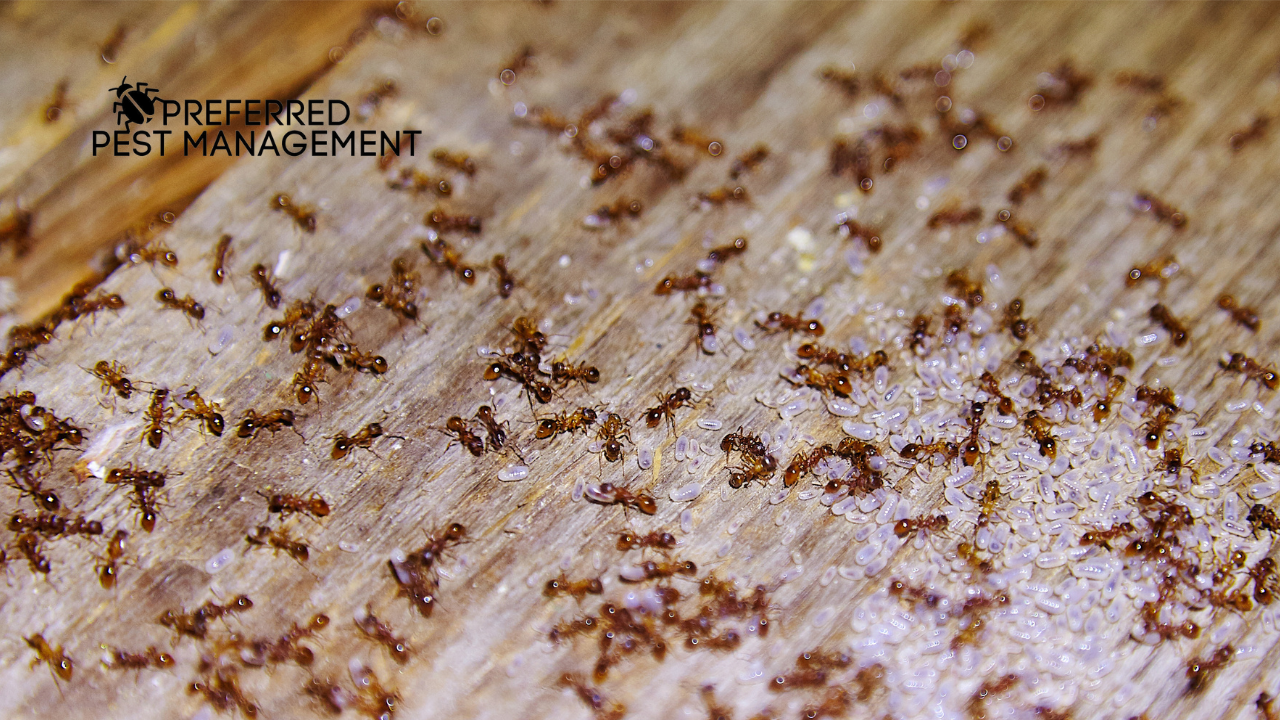
The ants walking through your kitchen are usually worker ants. They represent only a small portion of a colony that may contain thousands of ants, multiple nesting sites, and—in some species—more than one queen.
Effective ant control therefore requires more than killing the ants you can see. It requires understanding which ant is present, where the colony is likely located, and how that species responds to disturbance.
The Ants You See Usually Aren’t the Real Problem
Most ants seen inside a home are workers.
Their job is to leave the colony and search for resources such as:
- Food
- Water
- Sugars
- Proteins
- Grease
- Moisture
When a worker finds something useful, it can recruit other workers to the location.
That’s how a few ants around the kitchen sink can seemingly become a trail overnight.
Killing those workers may remove the visible evidence, but it doesn’t necessarily affect the colony producing them.
If the queen, brood, and remaining workers remain protected somewhere else, the colony can continue operating.
Think Beyond the Ant Trail
An ant trail is better understood as a transportation route than as the infestation itself.
The colony may be:
- Beneath soil
- Under landscaping
- Beneath concrete
- Inside a wall void
- Around plumbing
- Behind cabinets
- Near a foundation
- Under stones or landscape materials
- Inside damaged or moisture-affected wood
The visible ants are traveling between that colony and something they need.
This is why simply spraying the trail can produce disappointing results.
You’ve attacked the traffic without necessarily addressing where the traffic originates.
Why Contact Sprays Can Be Misleading

Many readily available insecticides are designed to kill insects that contact the product.
When sprayed directly on ants, the result can be dramatic.
The ants die.
That makes the treatment appear successful.
But immediate visible mortality and colony elimination aren’t the same thing.
If 30 workers are killed while thousands of ants remain elsewhere, the underlying infestation may continue.
This distinction is one of the most important concepts homeowners should understand about ant control:
Killing ants is not always the same as controlling the ant colony.
Some Ant Colonies Respond to Disturbance
This is where ant control becomes more complicated.
Certain ant species can respond to environmental stress or inappropriate treatment by changing their behavior.
Rather than remaining concentrated in one location, portions of the colony may relocate.
In species capable of maintaining multiple nesting sites or multiple queens, disturbance can contribute to the colony becoming distributed across additional locations.
This behavior is commonly described as budding.
Instead of one concentrated problem, homeowners may eventually encounter activity in several areas.

What Is Ant Budding?
Budding occurs when queens and workers leave an existing nest and establish or occupy another nesting location.
It is different from the familiar image of a winged queen flying away to establish an entirely new colony.
A portion of an existing colony essentially relocates.
Species with this type of colony structure can be particularly difficult to manage because what appears to be one infestation may actually involve interconnected nesting sites.
If those colonies are repeatedly disturbed without an overall control strategy, the problem can become harder to trace.
Not Every Ant Species Behaves the Same Way
This point matters.
It would be incorrect to say:
“Never spray ants because spraying always makes infestations worse.”
That’s too broad.
Ant species differ substantially in:
- Nesting behavior
- Colony size
- Number of queens
- Food preferences
- Foraging patterns
- Response to disturbance
- Seasonal behavior
A control method appropriate for one species may be ineffective—or counterproductive—for another.
That’s one reason identification should come before treatment whenever an ant problem is persistent.
Why Ant Identification Matters
To most homeowners, an ant is an ant.
To someone trying to eliminate a colony, species matters considerably.
North Texas homes can experience several types of ants with different behaviors and nesting habits.
Identification helps answer questions such as:
- Is the colony likely indoors or outdoors?
- Does the species commonly establish multiple nests?
- What foods are workers seeking?
- Is moisture contributing to the infestation?
- Could structural conditions be involved?
- Is baiting appropriate?
- Are exterior colonies contributing to indoor activity?
Without that information, treatment becomes guesswork.
Why Baits Work Differently Than Contact Sprays
Ant baits use the ants’ own foraging behavior as part of the control strategy.
Instead of killing a worker immediately, an appropriate bait allows foraging ants to collect the material and return toward the colony.
Food can be shared among colony members through a behavior called trophallaxis.
In simple terms, ants exchange food.
That behavior can allow an active ingredient to reach ants that never walked across your countertop—including members of the colony hidden inside the nest.
The process is intentionally different from immediately killing every visible worker.
Why You May Still See Ants Around a Bait
This can be difficult for homeowners.
You put out bait because you want fewer ants.
Then you see ants feeding on it.
The natural reaction is:
“There are more ants. I need to spray them.”
That can defeat the purpose.
If ants are actively accepting an appropriate bait, allowing workers to carry it back toward the colony may be part of the control process.
Spraying the ants around the bait can kill the workers before they complete that process or cause ants to avoid the area.
This is one reason combining random DIY treatments can sometimes produce poorer results than following one coherent treatment strategy.
Don't Take Our Word For It. Read What Over 140 Happy Customers Say About Our Service
EXCELLENT
Why Ants Sometimes Ignore Bait
Putting down bait doesn’t automatically solve an ant problem either.
Ant food preferences can change.
At different times, colonies may seek:
- Sugars
- Proteins
- Fats
- Other nutrients
A bait that is attractive under one set of conditions may receive little attention under another.
The bait also needs to remain usable and accessible to the target ants.
If workers consistently ignore it, simply applying more of the same material isn’t necessarily the answer.
Again, observation matters.
Why Ants Suddenly Appear in Another Room
This doesn’t automatically mean spraying caused the colony to spread.
Ants may change foraging patterns naturally.
Weather, food availability, moisture, construction activity, and other disturbances can alter where workers travel.
However, with species prone to multiple nesting sites or budding behavior, changing treatment patterns and repeated disturbance can complicate the infestation.
That’s why professionals look at the pattern of activity rather than assuming every ant trail represents an independent problem.
Heavy Rain Can Change Ant Behavior Quickly
North Texas weather can dramatically affect ant activity.
After heavy rainfall, underground nesting areas may become saturated.
Ants may move toward higher or drier locations, including structures.
Homeowners in Plano, Murphy, Richardson, Sachse, Rowlett, and surrounding communities may therefore notice sudden indoor ant activity after storms even when they haven’t previously experienced a significant problem.
Spraying the first ants that appear may address what you can see without answering the more important question:
Where are they coming from?
Drought Can Push Ants Indoors Too
Too much water can create ant problems.
So can too little.
During prolonged hot and dry North Texas conditions, ants may search more aggressively for reliable moisture.
That can draw them toward:
- Kitchens
- Bathrooms
- Laundry rooms
- Plumbing penetrations
- Irrigation areas
- Air-conditioning condensation
- Pet water bowls
Recurring ant activity around a moisture source can therefore provide a clue about what is attracting them.
Why Kitchens Become Ant Magnets
Kitchens provide an unusually attractive combination of resources.
Tiny amounts of food can be enough.
Common attractants include:
- Crumbs
- Sugar residue
- Grease
- Syrup
- Fruit
- Pet food
- Dirty dishes
- Garbage
- Recycling containers
Moisture around sinks, dishwashers, refrigerators, and plumbing can make the area even more attractive.
Cleaning doesn’t eliminate an established colony, but removing competing food sources can be an important part of control.
Bathrooms Can Have Ant Problems Without Food
Finding ants in a bathroom sometimes confuses homeowners because there isn’t an obvious food source.
Often the attraction is moisture.
Leaking plumbing, condensation, damp materials, and small gaps around pipes can provide both water and access.
Persistent ant activity around a particular bathroom or plumbing fixture may therefore justify looking beyond the visible insects.
Follow the Ants Before You Kill Them
This sounds counterintuitive, but an active ant trail can provide useful information.
Before immediately wiping it out, observe it.
Ask:
- Where are the ants entering?
- Where are they going?
- Are they disappearing beneath trim?
- Are they using a window?
- Are they coming through a plumbing opening?
- Is the trail leading outside?
- What are they feeding on?
- Does activity occur at a particular time?
That information can help identify the source of the problem.
The ants you’re tempted to immediately kill may actually be showing you where to investigate.
Exterior Conditions May Be Supporting the Colony
Indoor ant control shouldn’t always begin indoors.
Conditions around the exterior can support substantial ant activity.
Inspect for:
- Heavy mulch
- Landscape timbers
- Dense ground cover
- Tree limbs touching the house
- Shrubs against exterior walls
- Irrigation leaks
- Standing water
- Leaf debris
- Firewood
- Stones and pavers
- Food or pet bowls outdoors
Ant trails around the foundation can also reveal how workers are reaching the structure.
Entry Points Still Matter
Ants can exploit extremely small openings.
Common pathways include:
- Gaps around windows and doors
- Utility penetrations
- Plumbing openings
- Foundation joints
- Cracks
- Garage door gaps
- Roofline openings
- Weep holes
Not every opening should simply be sealed. Weep holes, for example, are intentional drainage components in brick veneer construction and shouldn’t be indiscriminately filled with caulk or foam.
The goal is to understand how the structure works while identifying unnecessary pest pathways.
Why Repeated Spraying Can Become a Cycle
A common DIY pattern looks like this:
Ants appear.
The homeowner sprays them.
The ants disappear.
Several days later, ants appear somewhere else.
The homeowner sprays again.
The cycle repeats.
At that point, the question shouldn’t necessarily be:
“What stronger spray do I need?”
A better question is:
“Why haven’t we reached the colony?”
Persistent ant activity usually deserves investigation rather than an endless escalation of contact treatments.
What Should You Do When You Find an Ant Trail?
Start by observing before reacting.
1. Identify Where the Trail Goes
Follow it in both directions if possible.
2. Remove Accessible Food
Clean crumbs, grease, spills, pet food, and other attractants.
3. Check for Moisture
Inspect sinks, plumbing, appliances, windows, and nearby water sources.
4. Avoid Randomly Combining Treatments
Multiple sprays, repellents, cleaners, and baits used simultaneously can interfere with one another.
5. Photograph the Ants
A clear close-up can sometimes assist with identification if the activity changes before an inspection.
6. Monitor the Pattern
Note when and where ants appear.
7. Get the Ant Identified
Persistent infestations are considerably easier to approach when you know which species you’re dealing with.
When Professional Ant Control Makes Sense
An occasional ant doesn’t necessarily require professional treatment.
Recurring activity deserves more attention when:
- Trails repeatedly return after DIY treatment.
- Ants appear in multiple rooms.
- Activity seems to originate inside walls.
- Ants are repeatedly found around plumbing.
- Large numbers appear after rain.
- You cannot locate the source.
- Different treatments haven’t solved the problem.
- The infestation appears to be expanding.
At that point, identifying the species, nesting behavior, environmental conditions, and likely colony location becomes more valuable than simply killing another group of workers.
The Goal Is Colony Control, Not Worker Control
This is the central idea.
The ants you see are evidence.
They’re telling you that a colony has found something useful enough to send workers into that location.
Killing those workers can make the evidence disappear temporarily.
But successful ant management asks a bigger set of questions:
What species is this?
Where is the colony?
What are the ants looking for?
How are they getting inside?
What conditions are supporting them?
Which treatment strategy matches their biology?
Answer those questions and you’re addressing the infestation rather than merely erasing the ant trail.
Frequently Asked Questions
Can spraying ants really make an infestation worse?
With some ant species and colony structures, disturbance or inappropriate treatment can contribute to colonies relocating or becoming distributed among additional nesting sites. It doesn’t happen with every ant species, which is why identification matters.
What is ant budding?
Budding occurs when queens and workers separate from an existing colony and establish or occupy another nesting location. Species capable of budding can be particularly challenging to control with approaches that repeatedly disturb only part of the colony.
Why do ants disappear after spraying and then come back?
A contact spray may kill the workers that were visible without eliminating the colony producing them. New workers can later resume foraging.
Should I spray ants that are eating bait?
Generally, you don’t want to immediately kill ants actively feeding on a bait intended to be carried back toward the colony. Follow the product directions or the instructions provided by your pest management professional.
Why won’t ants eat the bait I put out?
Ant preferences vary by species and can change depending on the colony’s nutritional needs and available food sources. An unattractive or inappropriate bait may simply be ignored.
Does killing worker ants kill the queen?
Not necessarily. Worker ants usually forage away from the queen and brood. Killing workers outside the nest may have little immediate effect on the reproductive members of the colony.
Why are ants suddenly appearing after heavy rain?
Rain can saturate or flood nesting areas and change normal foraging behavior, sometimes pushing ants toward homes and other protected structures.
Why do I have ants in my bathroom?
Water may be the attraction. Ants can seek moisture around plumbing, condensation, leaks, and damp structural areas even when there is little food available.
Should I follow an ant trail?
Observing where ants enter, where they travel, and what they’re seeking can provide useful clues about the infestation before treatment begins.
Ant Problems in North Texas
Ant pressure is common throughout Plano, Murphy, Richardson, Sachse, Rowlett, and surrounding North Texas communities, but effective control isn’t simply a matter of finding the strongest product and spraying every ant you see.
Preferred Pest Management approaches recurring ant problems by looking beyond the visible workers to understand the species, colony behavior, entry points, environmental conditions, and other factors allowing the infestation to continue.
Because when ants keep coming back, the most important question isn’t how many you can kill.
It’s where they’re coming from and why they’re there.